Be More Healing House

Be More Healing House

Wishing you many blessings in this new year. The Jonah Malcolm House Community would like to thank our extended community for the incredible support.

The houses at 1301 Moreland Ave Baltimore, MD 21216, located on the serene St. Peter’s Cemetery grounds in West Baltimore, was once home to the Jonah House peace, nonviolence, and anti-war activist communities, and more recently home to the Jonah Malcolm House food sovereignty community, and now is proposed as the home of Be More Healing House, envisioned by founder and volunteer board president, Ethel Jemila Sequeira, and a team of healers, activists, and creatives. This new initiative needs immediate financial support, and St. Peter’s Cemetery Restoration Fund nonprofit looks forward to fiscally sponsoring this important initiative via your backing! Please see below for the proposal from the founder. If you would like to make a donation, please do so here: https://jonahhouse.org/d2/

Be More Healing House: https://bemorehealinghouse.com/

The Opportunity: A Sanctuary in West Baltimore

Today, we have a critical opportunity to secure two properties located on a 22-acre sanctuary in West Baltimore as the physical home for a new nonprofit. This location is unique: a dense forest and two properties that offer much-needed respite. In 2019, the founder, Ethel Jemila Sequeira, moved here and currently lives at one of the properties.

In a West Baltimore community often lacking accessible “green spaces,” this land provides a profound asset:

  • Respite and Healing: Miles of paths where you encounter deer, hear the sounds of nature, and find quietude for reflection.
  • A Natural Asset: This land is a vital, healing counterpoint to the urban environment, a place where nature cultivates wellness.

The Mission: To foster healing and transformation in underserved communities by providing access to indigenous/ancestral practices, holistic wellness, creative expression, and community-based agriculture, within a supportive, natural environment.

Our new organization will be a vital resource for Baltimore’s BIPOC communities, serving as a hub for:

  1. Land & Food Justice: Workshops, technical assistance, and networking for Black farmers and food advocates. 
  2. Healing & Creativity: Retreats and collaborative space for creatives (artists, filmmakers, writers) to find rest and inspiration.

We have the support of the Saint Peter’s Cemetery Restoration Fund, Inc., the Jonah House Community, and the commitment of dedicated prospective Be More Healing House board members.

The Urgent Ask: Sustaining the Launch

We are at the most critical financial moment to cover the bare-bones operational costs (utilities, insurance, supplies) while we finalize the nonprofit structure and secure long-term funding. 

Sustaining the Mission through Financial Contribution: Currently, to sustain the expenses of the houses, we have an annual budget of $25,000, and we unfortunately do not have enough resources to sustain another month. We would love to reach this effort via sustaining memberships. For example, this goal could be reached with your commitment of $20.00 per month. However, if especially in the first few months you’re able to contribute more generously, the additional support would be very much appreciated.

If you would like to make a donation, please do so here: https://jonahhouse.org/d2/

Any amount you are able to contribute will be appreciated.

Your urgent, personal contribution now is not just a donation; it is a direct investment in:

  • Insuring this land as a healing asset for West Baltimore’s neighborhood.
  • Providing funds to continue living at the property and to launch our new nonprofit there.  
  • Ensuring our work supports Black and Indigenous farmers and artists for generations to come.

Please help us launch this legacy organization today as an investment in our collective healing for generations to come.

The Jonah Malcolm Community: A New Year, Renewed Vision, and New Name

In 2023, Jonah House celebrated its 50th anniversary with an incredible turnout for the screening of Devout and Dangerous, a film that honored our rich legacy of peace and social justice. Over the decades, Jonah House has been a steadfast presence in West Baltimore, nurturing a mission rooted in anti-war activism, food justice, and community care.

However, 2023 also brought challenges. After many years, we learned that Jonah House would no longer receive annual financial compensation for our care of St. Peter’s Cemetery. This significant change prompted deep reflection about our mission, vision, and the future of our work. Generous contributions from donors helped stabilize us during this transition period, but it became clear that we needed to reimagine Jonah House’s role in the community.

After thoughtful discussions with residents, the St. Peter’s Cemetery Restoration Fund board, and the Friends of Jonah House, we recognized that our focus had shifted over the years. While anti-nuclear activism was central to our founding, those efforts have naturally slowed as key members have retired. In recent years, Jonah House has been increasingly involved in addressing local needs, such as mentorship through group meetings and partnering or collaborating with local farmers, food organizations, and groups actively working to create a healthy, culturally relevant, and sustainable local food system. These discussions also prioritized preserving the Jonah House legacy by offering the residences a serene environment for reflection, fellowship, and creativity.  To not only preserve the legacy of Jonah House, there was overwhelming support for renaming the Jonah House.

Over the past decade, the demographics of the Jonah House community residents have changed to reflect the surrounding neighborhoods.  The Jonah House residence is located in West Baltimore, Maryland, one of the predominately African-American households that continue to lack access to affordable, fresh, and culturally relevant foods.  

To reflect these changes—and to honor the profound impact of Malcolm X’s legacy in addressing the needs of Black communities—we are proud to announce that Jonah House will become the Jonah Malcolm Community in 2025. This new name acknowledges our evolution and recommits us to serving the predominantly African American neighborhoods of West Baltimore with justice, dignity, and care.

As we move forward, we remain deeply grateful for the decades of support from our friends, donors, and collaborators. Together, we will continue to uphold the spirit of Jonah House while embracing the future.

If you would like to support our work, please do so here.

Jonah House Visioning Gathering

We gathered at Jonah House as creatives, activists, and peace-makers to share community, honor our roots, and brainstorm a mission and vision.

We also shared a wonderful meal made by Jemila with ingredients from the community garden. Stay connected in the coming weeks for updates regarding our mission and for information about a celebration at Jonah House. We hope you’ll join us!

If you’d like to support the work and community of Jonah House, please make a donation or share ideas with us.

Jonah House 50th Anniversary Gathering

On June 10, 2023, many from the Jonah House community, past and present, gathered by webinar to commemorate our 50th Anniversary. The webinar titled, Jonah House: Fifty Years of Experiment in the Beatitudes, included the following speakers from our wonderful community of peacemakers: Willa Bickham, Brendan Walsh, John Bach, John Schuchardt, Mike Middleton, Barb Kass, Ellen Grady, Greg Boertje-Obed, Michele Naar-Obed, Carol Gilbert, Susan Crane, Gary Ashbeck, Katie Lautar, Jemila Sequiera, Frida Berrigan, & Jerry Berrigan.

Fr. Terry Moran put together the below presentation showcasing Johah House’s history, with beautiful photos from Frida Berrigan, Jerry Berrigan, Ellen Grady, and others. In Terry’s words, “May your lives be rich with the spirit of Jonah House!”

Sayonara to Joe Byrne

By Joe Byrne

As some of you know by now, I’ve left Jonah House. At the beginning of April, I moved down to Pinehurst, North Carolina, to live with, and take care of, my 90-year-old mother. My mom is at the point where she needs to either move into assisted living, or live with one of her kids. She’s chosen the latter course. And my siblings and I, as well as my mom and I, decided that I was the one most available to make the move, having no family of my own. That said, I did have a community I was leaving behind in Baltimore, and many friends, so my leaving was a challenge in that regard.

I moved to Jonah House in October 2015. I joined the community anchored by the Parr-Brown family–Tucker and Emily and little Auggie, then a year-and-a-half old. Within a year, we welcomed a new member into the community, little Evie, Tucker and Emily’s second child. Also part of Jonah House at that time were the “emeritus” members living separately in the cottage: Liz McAlister, Sr. Ardeth Platte, and Sr. Carol Gilbert.

The Parr-Brown family decided to move back west after two years; Liz, Ardeth, and Carol had left Jonah House the year before. I remained behind to form a new community. Joining me in 2017 were Paul Magno, Ausar Amen, Bow Williams, and Jemilla Sequiera.

The past six-and-a-half years at Jonah House have been a very rich time for me. I was able to be part of a tradition that I had admired for almost thirty years before I finally moved to Jonah House. It was also a challenging time in that the community was going through some changes, with long-time community members (including a founder) leaving Jonah House, and remaining members trying to envision a new direction and carrying on.

In my time at Jonah House, I was able to develop strong bonds with other community members, with the folks in the neighborhood who came on Tuesdays for food assistance, with those who attended Jonah House liturgy, and with the land itself. Over the six years I got to know the twenty-two acres of St. Peter’s Cemetery, where Jonah House resides, pretty well. I got to know the trees and flowers (and many, but not all, of their names), and the animals–the flora and fauna. I personally met raccoons, foxes, and deer; as well as barn owls, red-shouldered hawks, and guinea fowl (now no more due to the foxes!). The deer population in the cemetery grew from zero to eight in the time I was at Jonah House. Too many, actually. When I saw the deer (pretty much every day) I would say “Hello deer–and I don’t mean that affectionately.” That’s because they ate or otherwise damaged so many of the things I planted!

I also need to announce that my canine companion, Pema, has also left Jonah House. She is with me in North Carolina. It’s going to take some time for Pema to get used to her new living arrangement. In St. Peter’s Cemetery, I let her roam. And since the main gate was open most of the time, this means I also let her roam the neighborhood surrounding the cemetery. I hope the neighbors were fond of Pema; then again, maybe those who halted behind her and honked their horns when Pema paraded down the middle of Bentalou Street are happy she’s moved on. But at least no one ran her over or called Animal Control.

I will miss Jonah House, where I worked, prayed, and played for six plus years. But Jonah House continues, both as intentional community, and as extended community. There will still be a Jonah House when the community celebrates its 50th anniversary in 2023. I hope to return then, and will probably return before then, at least once.

For what it’s worth, all those I leave behind have my blessing, as do those who will come after me. I conclude with the phrase used by the early Franciscan friars as a greeting (and likely as a farewell): “Pax et bonum!” That is, “peace and good to you!”

Love One Another

Seedlings Transplanted Along North Fence

By Joe Byrne

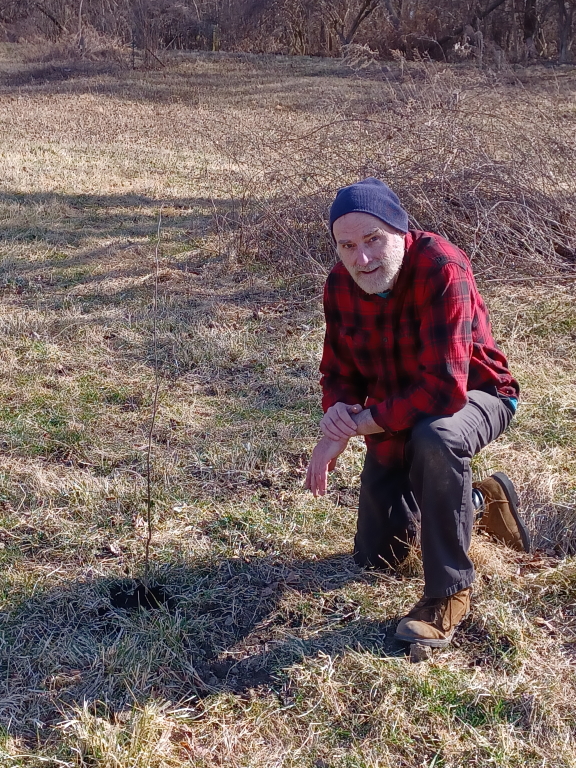
Today, with the help of a volunteer (Adam) I was able to get to a little project I’d been meaning to do for a while now. We transplanted some trees along the north fence of the cemetery, in the north-west quadrant.

On the other side of the north fence is an industrial site, including a lot of rusting equipment and shipping containers, as well as a mountain of shredded rubber tires. I thought it would be great to put up some trees to screen the cemetery from the industrial site. My idea was to use two different kind of trees: a top-canopy tree and a mid-level canopy tree. The two trees together, in two parallel rows, would provide a better screen than just the tall trees. The trees would have to be native and it would be great if they were already present in the cemetery. It would also be good if they could withstand the polluted run-off from the industrial site. Even better would be trees that would be unattractive to deer, so the deer wouldn’t crop the trees, or damage the tender trunks by rubbing off the bark with their horns (it’s the bucks that do that, not the does). A few years ago we planted some white pines along the north fence. A few still remain but quite a few of them died due to run-off pollution and damage from deer.

In the cemetery, we found some seedlings that I think fit the criteria listed above. For the top canopy tree, in a row of four closest to the fence, we transplanted some sycamore seedlings. There is already a very large sycamore tree along the north fence and it seems to be doing well. However we figured the very young sycamore trees would initially be susceptible to deer damage, so we put fences around them.

I’ve been experimenting with tree fencing for a while now. Putting up wooden posts and putting metal fencing around them does a pretty good job at protecting the trees, but that’s a lot of work, and it’s unsightly. The alternative I’ve come up with is to use leftover green plastic fencing (a kind of chicken mesh), and s’more sticks (doll rods) that we found at the Maryland Food Bank once upon a time. You cut of a length of fencing, use cheap wire ties to make it a closed circle. Then weave a s’more stick into the fencing and push it into the ground. Do three more in a circle (really, a diamond). After that, secure the bottom of the fencing with metal tent stakes. I found that, with just the s’more sticks, the fencing will topple over in a strong wind. With stakes, they stay upright and secure. The fencing looks kind of flimsy, but it looks solid enough to fool the deer. They could knock it down if they wanted to, but they don’t seem to want to. Even better, from a distance you can hardly see the green fencing.

After we had all the sycamore seedlings in, and fenced off, we planted four red bud trees in a row in front of the sycamores. Red buds are typically about half as high as mature sycamores. We already have some mature red buds in the cemetery, and they produce a lot of seedlings. I’ve transplanted some red bud seedlings before and noticed that the deer don’t mess with them. It might be that when they get bigger, the deer (the bucks) will go after them; so fencing might be necessary later. But for this planting, we left them without fencing.

One project done, but there are still plenty of places to plant more trees in the cemetery. Next time we plant trees, we’ll put the word out so that some those reading this might help out.